


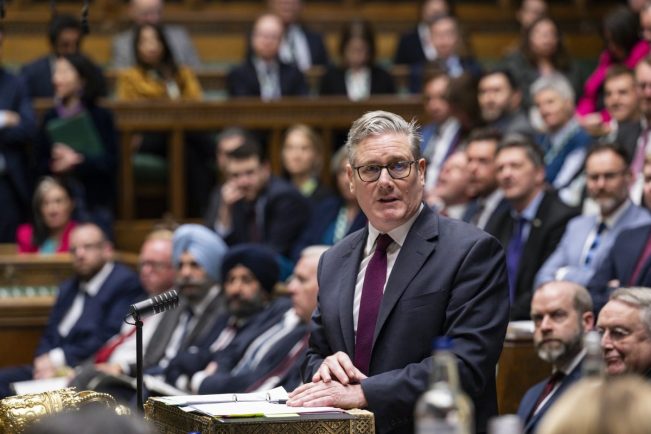
Sir Keir Starmer’s final major policy announcement before leaving office has been overshadowed by the revelation that almost £5 billion of the defence spending he promised has yet to be funded.
The outgoing Prime Minister unveiled a long-awaited Defence Investment Plan (DIP) on Tuesday, describing it as the biggest sustained increase in defence investment since the Cold War and a vital step towards preparing Britain for an increasingly dangerous world.
The package includes an additional £15 billion for military equipment and capabilities over the next four years, with major investments in drones, warships, nuclear deterrence, munitions, combat aircraft and military infrastructure. Defence spending is expected to rise to 2.7 per cent of GDP by 2030 under the plans.
However, Treasury documents released alongside the announcement reveal that only £10.3 billion of the additional funding has so far been identified, leaving a £4.7 billion shortfall to be addressed in a future Budget.
That means Andy Burnham, who is widely expected to succeed Sir Keir later this month, will inherit the task of finding the remaining money if the spending commitments are to be fulfilled.
The issue became even more politically awkward for the outgoing Prime Minister after Defence Minister Luke Pollard acknowledged that the next Chancellor would have to “find the resources” required to close the funding gap. According to reports, Mr Burnham’s team was only informed of the scale of the shortfall when the Treasury published its financial breakdown alongside the plan.
Critics argue the episode raises serious questions about the Government’s handling of defence policy.
The Defence Investment Plan was originally expected nearly a year ago but was repeatedly delayed amid disputes over funding. The disagreements ultimately contributed to the resignation of former Defence Secretary John Healey, who argued that the Government was failing to commit sufficient resources to meet Britain’s growing security challenges.
Mr Healey renewed those concerns this week, warning that Britain would still be spending only around 2.7 per cent of GDP on defence by 2030 despite NATO warnings that Europe faces an increasingly dangerous security environment. He has repeatedly called for a clear timetable to reach 3 per cent of GDP on defence spending.
That timetable remains absent.
Although Sir Keir insisted Britain is on a path towards spending 3 per cent of GDP on defence during the next Parliament, he declined to provide a specific target date. Defence experts and some MPs have questioned whether the Government’s plans go far enough given NATO’s ambition for members to move towards spending 3.5 per cent of GDP on core defence by 2035.
Questions have also been raised about how the spending increase is being funded.
Rather than relying on economic growth or additional borrowing, ministers have chosen to divert money from other parts of government. Departments have been instructed to reduce capital spending, while transport, energy and infrastructure projects are expected to contribute significant savings. The Department for Transport is expected to provide hundreds of millions of pounds in savings, while the Department for Energy Security and Net Zero is expected to contribute around £2 billion.
Road schemes including the A38 Derby Junctions project and the A46 Newark Bypass have reportedly been identified as potential casualties of the reprioritisation.
Supporters of the plan argue that Britain’s armed forces urgently require investment after years of delays and procurement failures. The package includes more than £5 billion for drone technology and autonomous systems, billions for the Tempest next-generation fighter programme and substantial investment in the UK’s nuclear deterrent and submarine fleet.
Yet the central political question remains unresolved.
Having spent more than a year negotiating, delaying and revising the Defence Investment Plan, Sir Keir has left office having announced £15 billion of additional spending without fully identifying where all of the money will come from. Whether the remaining £4.7 billion is found through spending cuts, tax rises or further borrowing will now be a decision for the next government.