


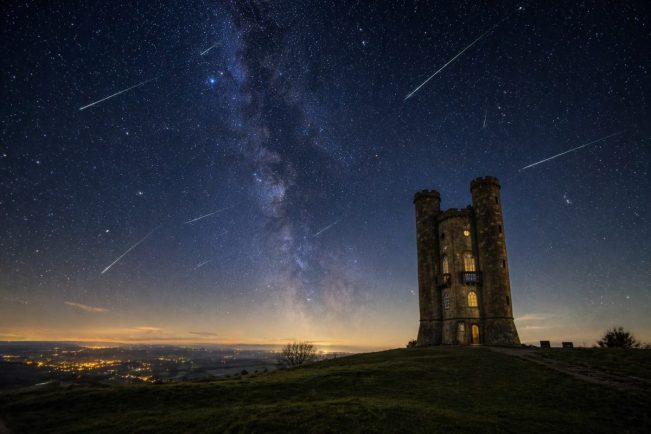
Clear skies and mild spring weather are expected to provide favourable viewing conditions for the peak of the annual Lyrid meteor shower across much of the UK tonight, Wednesday 22 April.
The Lyrids, which have been active since 16 April, are forecast to reach their maximum overnight, with observers likely to see between 10 and 15 meteors per hour.
Occasional surges could produce significantly higher rates, with some estimates suggesting bursts of up to 100 meteors per hour under optimal conditions.
The display occurs each year as Earth passes through a stream of debris left by Comet Thatcher, a long period comet that orbits the Sun approximately every 415 years.
Clear skies and limited moonlight
According to Royal Museums Greenwich, the meteor shower’s peak falls two days before the First Quarter Moon, meaning lunar brightness will have only a limited impact on visibility.
High pressure dominating the UK’s weather pattern is expected to bring largely cloud free skies. While some early cloud is possible across Northern Ireland, west Wales and parts of eastern England, most areas are forecast to turn clear by late evening.
Temperatures, however, are expected to fall quickly after sunset. Overnight lows of 3 to 5°C are forecast for much of the country, with near freezing conditions possible in parts of north east England and eastern Scotland.
Favourable viewing conditions are expected to continue into Thursday night, although increasing cloud may move into eastern Scotland and eastern England by early Friday.
Best time and how to watch
Astronomers say the best time to observe the Lyrids will be after 22:00 BST, once skies are fully dark. Viewing conditions should improve further after around 02:00 BST, when the Moon sets below the horizon, leaving darker skies.
Observers are advised to move away from street lighting and urban light pollution where possible. With the Moon positioned in the north western sky earlier in the night, looking towards the east or south east may provide darker viewing areas.
The meteors can be seen with the naked eye, appearing as brief streaks of light across the sky. Photography is possible using long exposure techniques and tripod mounted cameras.
One of the oldest recorded showers
The Lyrid meteor shower is among the oldest known astronomical events, with records dating back nearly 3,000 years to observations by Chinese astronomers.
The shower takes its name from the constellation Lyra, from which the meteors appear to radiate. It typically occurs between 16 and 25 April each year, with a peak around 22 April.
Lyrid meteors are known for their brightness and occasional fireballs, which can outshine planets such as Venus. These flashes are caused by particles, often no larger than a grain of sand, burning up as they enter Earth’s atmosphere.
Larger fragments, sometimes comparable in size to a grape or acorn, can produce brighter fireballs with lingering trails, known as trains.
Although the Lyrids return annually, Comet Thatcher itself will not be visible from Earth again until 2283.
Main Image: For illustration only