


As the sun begins to set on a warm June evening, many people notice dark shapes darting and swooping through the sky at surprising speed.
For some, the sight can be unsettling. Popular culture has often portrayed bats as mysterious or even frightening creatures. Yet the reality could not be more different.
Britain’s bats are harmless, fascinating and play a vital role in the natural world. In fact, if you have bats visiting your garden, it is usually a sign of a healthy local environment.
June is one of the best times of year to spot them. As temperatures rise and insect numbers increase, bats emerge from their daytime roosts to feed, often putting on an impressive aerial display just as daylight begins to fade.
Many people are surprised to learn that the UK is home to 18 different species of bat. The most commonly seen are pipistrelles, which are also Britain’s smallest bats, with some weighing little more than a £1 coin.
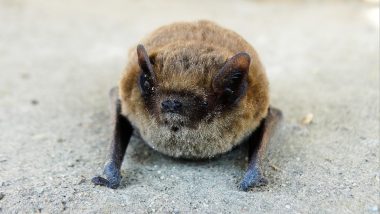 A pipistrelle. Image by
 Despite their tiny size, bats are remarkably effective hunters. Using a sophisticated form of echolocation, they emit high-frequency sounds and listen to the returning echoes to build a picture of the world around them. This allows them to catch insects in complete darkness with astonishing accuracy.
A single small bat can consume thousands of insects in a single night, helping to control populations of midges, mosquitoes and other flying insects.
Contrary to popular myths, British bats are not interested in people and do not become tangled in human hair. They are shy animals that actively avoid contact with humans whenever possible.
Another misconception is that bats are aggressive. In reality, they are among the most vulnerable wild mammals in Britain and face a range of pressures, including habitat loss and disturbance to their roosts.
In fact, bats receive some of the strongest legal protection of any wildlife species in the UK.
All bat species and their roosts are protected by law. It is illegal to deliberately harm, capture or kill a bat, and it is also illegal to damage or destroy an active roost.
This protection reflects their importance to the ecosystem and the challenges many species have faced over recent decades.
Occasionally, a bat may find its way indoors, particularly during the summer months when young bats are learning to fly.
While this can come as a surprise, there is usually no need to panic.
Experts advise remaining calm, keeping pets and children away from the room and turning off any lights. Open windows and interior doors leading to the outside, then leave the room if possible. In most cases, the bat will find its own way out once conditions are quiet and dark.
If the bat appears injured, cannot fly, or remains inside for an extended period, specialist advice should be sought from a local bat rescue group or wildlife organisation.
People should avoid handling bats unless absolutely necessary. Although the risk is extremely low, bats can bite if frightened or injured. Anyone who must handle a bat should wear thick gloves and seek expert guidance.
There are also simple ways people can help bats in their own gardens.
Planting flowers that attract insects, reducing pesticide use and maintaining a small wildlife-friendly area can all provide valuable feeding opportunities. Ponds are particularly attractive to bats because they attract large numbers of insects.
Bat boxes can also provide additional roosting sites, especially in areas where older buildings and mature trees are becoming less common.
For those willing to spend a few minutes outdoors on a warm evening, bats offer one of nature’s most remarkable spectacles.
Watch the sky shortly after sunset and you may spot them zig-zagging silently overhead, expertly hunting insects as daylight fades. Their speed, agility and precision are extraordinary to witness.
Far from being something to fear, Britain’s bats are a sign that nature is thriving around us.
And on a warm June evening, they are among the most fascinating neighbours we could hope to have.
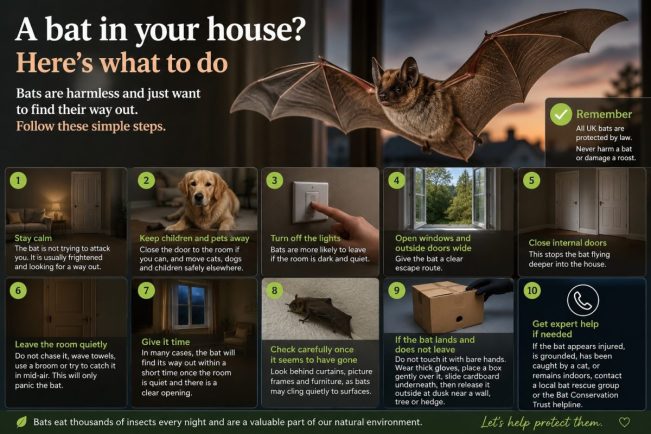
If a bat flies into your house, what should you do?
Stay calm
The bat is not trying to attack you. It is usually frightened and simply looking for a way out.
Keep children and pets away
Close the door to the room if you can, and move cats, dogs and children safely elsewhere.
Turn off the lights
Bats are more likely to leave if the room is dark and quiet.
Open windows and outside doors wide
Give the bat a clear escape route. Pull curtains back fully if possible.
Close internal doors
This stops the bat flying deeper into the house.
Leave the room quietly
Do not chase it, wave towels, use a broom or try to catch it in mid-air. This will only panic the bat.
Give it time
In many cases, the bat will find its way out within a short time once the room is quiet and there is a clear opening.
Check carefully once it seems to have gone
Look behind curtains, picture frames and furniture, as bats may cling quietly to surfaces.
If the bat lands and does not leave
Do not touch it with bare hands. Wear thick gloves, place a small box gently over it, slide cardboard underneath, then release it outside at dusk near a wall, tree or hedge.
Get expert help if needed
If the bat appears injured, is grounded, has been caught by a cat, or remains indoors, contact a local bat rescue group or the Bat Conservation Trust helpline.
Important: All UK bats are protected by law. Never harm a bat or damage a roost.
Five Things You Might Not Know About Bats
- Britain has 18 species of bat.
- All British bats are protected by law.
- Bats are the only mammals capable of true powered flight.
- A bat can eat thousands of insects in a single night.
- Many bats live for more than 20 years in the wild despite weighing only a few grams.