


Think you know everything about Droitwich, or Droitwich Spa, to give the town its official name? From its salty origins, and iconic orange creations to some impressive former residents, this historic town has plenty of stories to tell and there’s more to Droitwich than meets the eye!
Even if you’re a lifelong local, we’ve dug up some surprising facts that might just make you see our Worcestershire gem in a whole new light. So, sit back, relax, and discover 10 things you probably didn’t know about Droitwich!
1. The birthplace of a Pilgrim Father
Edward Winslow, one of the leaders of the famous 1620 Mayflower voyage and a founder of the Plymouth Colony in America, was born in Droitwich in 1595. His role in the early history of the United States, including signing the Mayflower Compact, the constitutional law created by these early colonists, offers Droitwich an unexpected link to American history.
2. Droitwich Brine – the Dead Sea of the Midlands
You may be familiar with Droitwich’s legacy as a spa destination – hence the name ‘Spa’ being added to its name in the 19th century – which was due to the purported healing properties of the town’s natural springs for ailments like arthritis, rheumatism, and other joint problems.
But did you know that the Droitwich Brine springs are renowned for having some of the strongest natural salt water in the world, containing nearly 30% natural salts. This is 10 times more concentrated than normal sea water, making it as dense as the Dead Sea. No wonder the Romans named the town Salinae!
The Droitwich Spa Lido – one of the few remaining outdoor saltwater pools in the UK – continues to use the town’s natural brine, offering swimmers a taste of this historic and salty experience.
3. The origin of Worcestershire Sauce’s secret ingredient
Droitwich is linked to the creation of the world-famous Worcestershire Sauce. The sauce’s salty tang is believed to have originally come from the town’s brine springs when it was first invented locally in 1837 by Worcester chemists John Wheeley Lea and William Henry Perrins (of Lea & Perrins fame). The condiment is still a culinary staple in British kitchens today with its iconic and easily recognisable orange and black label.
4. John Corbett: The Salt King
John Corbett, known as the “Salt King,” was an industrialist who made his fortune from the local salt mines in the 19th century. However, he was also a philanthropist and vastly improved the living conditions of workers and the infrastructure in Droitwich.
Corbett was deeply committed to education and healthcare. He funded the construction of several schools in and around Droitwich, ensuring that children from working-class families had access to proper education, financed the Droitwich Infirmary, which provided medical care to local residents, and was a pioneer in providing good quality housing for his workers. He built affordable homes for salt workers and their families in the area, an uncommon practice at the time.
Corbett invested heavily in the restoration and beautification of the town too, paving the way for it to become a popular spa destination, and his legacy includes much of Droitwich’s impressive Victorian architecture. The grand Chateau Impney, a French-style chateau, was built as a gift for his wife and it was used as a convalescent hospital during World War II.
5. Worcestershire’s most prestigious address
Speaking of impressive estates, Droitwich is also home to one of the most expensive properties in Worcestershire, Caulin Court. The nine-bedroom Regency style property comes complete with nearly 19 acres of parkland, a fully stocked fishing pool, an impressive leisure complex of swimming pool, sauna, steam room and gym and even its own separate three-bedroom guest cottage.
Of course, you’ll certainly need deep pockets since it also comes with a £7 million+ price tag! Thankfully for prospective home owners, there are still many local Droitwich properties on the market with a more modest valuation. Indeed, the average house price in Droitwich over the last year was £288,027 according to Rightmove.
6. A record breaking number of pubs? Cheers to that!
Droitwich Spa was reputed to have the most public houses per person in England during the Victorian era, particularly in the late 19th century. At its peak, the town had around 30 pubs, which was a significant number given its relatively small population at the time. Indeed, by 1906 there was apparently one pub per every 100 people. This high concentration was likely due to Droitwich’s thriving salt industry, which attracted workers, traders, and travellers who frequented the town’s inns and taverns. Today Droitwich is home to a more modest number of establishments, with one pub for approximately every 1,600 residents.
7. Bear on the run!
Local legend tells of a bear that managed to break free from its train carriage while passing through Droitwich in the 1920s. The bear was thought to be part of a traveling circus, and as the train stopped at Droitwich Spa station, the animal somehow escaped, causing quite a stir among the locals.
According to the tale, the bear wandered through the streets, prompting panic among residents who were understandably shocked to see such a large, wild animal loose in their quiet town, especially when rumours went around of its bloodthirsty, man-eating nature. As a result, when the bear was finally apprehended it was shot, although sadly it turned out that the bear had actually been a very friendly pet.
8. The “Devil’s Horns of Wychbold”
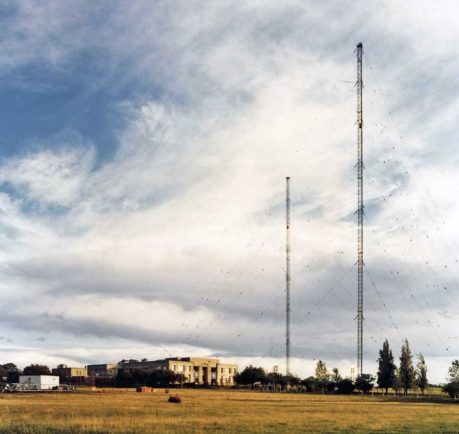
Whilst you might be mistaken for imagining an other-worldly being, the so-called “Devil’s Horns of Wychbold” are actually two tall radio masts (over 213 metres tall) located at Wychbold, a village on the edge of Droitwich. These iconic masts earned their nickname thanks to their striking silhouette and are part of the Droitwich Transmitting Station, one of the most significant radio transmission sites in the UK.
Built in 1934 by the BBC for long-wave radio broadcasting, the Station’s powerful long-wave transmission could reach far across the UK and even into parts of Europe.
During World War II, Droitwich Station became an essential part of British communications. The long-wave signals were used to broadcast crucial information to the public and after the war, the Station continued to be a key site for broadcasting and was central to the BBC’s long-wave service. In the Cold War, the station’s robust infrastructure was also a backup communications site in case of national emergencies.
The “Devil’s Horns” masts remain operational today, transmitting BBC Radio 4 and other long-wave services.
9. Home of the cleaner carpets
An icon of the cleaning world, the easily identifiable orange “Vax” was the first vacuum cleaner of its kind which could also wash carpets and hoover up liquids and was invented by local Droitwich inventor Alan Brazier in 1977. Initially Brazier sold it door-to-door before the Vax became the nation’s best-selling vacuum in 1989, with global sales to follow, making Brazier a multi-millionaire. Whilst the head office has moved down the road to Birmingham, the service, warehouse, and depot operation remains in Hampton Lovett on the outskirts of Droitwich.
10. The birthplace of several celebrities
There have been a number of impressive Droitwich born and bred “Monners” over the years, from ground-breaking industrialists and inventors to the more recent comedy chops of Rik Mayall and entrepreneur ‘dragon’ Nick Jenkins of Moonpig fame.