



You may be an American dreaming of moving to the UK, or a UK resident looking for career opportunities in the US. Understanding the cost of living in these countries helps you see where it is more affordable to live. The difference is felt in almost everything from housing and healthcare costs to salary levels and taxes.
American House Prices vs. the UK
Below are the average housing prices in the United States and the United Kingdom:
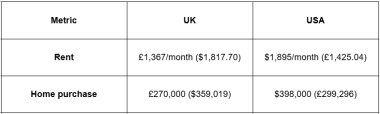
It may seem that buying in the UK is cheaper; however, in the US, for the same money, you will get a house with more square footage or a larger plot of land. As for renting in the UK, this amount will cover a smaller, furnished apartment. In the US, you will get more space, but the necessary furniture may be limited or not included at all.
If we look at the ratio of purchase prices to rents, the US market appears slightly more overheated: housing prices there are somewhat higher relative to rents. In the UK, the situation is a bit softer, although housing remains very expensive, and housing costs are projected to increase by 41% over five years for both renters and homeowners.
Cost of Utilities in the UK vs. the USA
In the UK, there is currently a limit: from April 1 to June 30, 2026, the maximum cost for electricity and gas is £1,641 per year for a typical household paying by direct debit. But even with this, utilities are still generally more expensive than in the US. On average, it comes to about £238 per month versus $208 (£158). This is more than 50% higher.
The main reason is housing. In the UK, many older homes retain heat poorly and require more energy. In the US, homes are more often newer and more energy-efficient. In addition, the UK relies heavily on imported gas, whereas the US produces a significant share domestically.
Transportation Costs
In the US, transportation costs are higher because most households own a car. This provides greater mobility and more opportunities to live in suburban areas, but it also adds fixed expenses. In the UK, public transportation is more developed and accessible to most people, while nearly half of Americans have no access to it at all, and trains are rarely used for everyday travel. At the same time, public transport in the UK is more expensive. In London, a monthly pass costs £201.60 (zones 1–3) or up to £447 (zones 1–9), whereas in New York it is $132 (£105).
Grocery and Food Prices
In the UK, people spend less on groceries: about £291 for two people and around £400 for a family of three. In the US, it’s $650–750 (£503–582) per month, which is noticeably higher. This is largely because store-brand products are widely used in the UK—they’re cheaper and make up a large share of sales. In the US, these options exist too, but they are chosen less often.
At the same time, it’s easier to save money when eating out in the US. Portions are bigger, and free drink refills are common. A meal at a good restaurant costs about $75 (£58) in the US versus £80 in the UK. On average, Americans spend around $253 per month on dining out, while a British couple spends about £99.
Household Debt
In the US, total household debt at the end of 2025 reached $18.8 trillion (£14.1 trillion), most of which was accounted for by mortgage loans. The next largest contributors to total debt are credit card debt, student loans, and car title loans. The latter are popular because of their lenient requirements, but studying a guide before taking them out is extremely important, as it helps you understand the terms and possible risks, and avoid long-term debt in advance.
In the UK, the largest share of household debt is mortgages: in January 2026, the volume was £4.1 billion ($5.45 billion), while consumer credit was £1.7 billion ($2.26 billion). Overall, American households have more debt because the variety of credit products is wider. At the same time, in the UK, people mainly pay off housing-related debts.
UK vs. USA Taxes
Raising children is expensive in both countries, but in the US, most of the costs are borne by families, who spend around $16,000 per year. There is no nationwide free childcare program, but there are state-level subsidies and tax benefits, such as the Child and Dependent Care Tax Credit.
In the United Kingdom, the government provides significant support. Some parents can receive 30 free hours of childcare per week or partial coverage of nursery costs. Without subsidies, prices are high—about £189 ($251) per week in England, £133 ($177) in Scotland, and £166 ($221) in Wales.
Healthcare Costs
This is where the difference is most noticeable. In the UK, the NHS covers most basic costs: prescriptions cost £9.90 ($13.16), and dental care ranges from £27.40 to £326.70 ($36–$434). In the US, healthcare is a major expense, averaging about $15,474 (£11,637) per person per year. Even with insurance, a family pays around $6,850 (£5,151) per year plus a deductible of about $1,886 (£1,418).
Childcare Costs
Childcare is expensive in both countries, but in the US, the costs mainly fall on families: in 2024, the average cost was $13,128 per year (£9,873). In the US, there is no nationwide free childcare program as in the UK, but there are some subsidies and tax benefits at the state level, such as the Child and Dependent Care Tax Credit.
The UK offers substantial government support, for example, 30 free hours of childcare per week, or for some families, part-time nursery places. Without subsidies, prices remain high—about £189 ($251) per week in England, £133 ($177) in Scotland, and £166 ($221) in Wales.
article written by Marsha Welch