


Your car’s shock absorbers work harder than you might think. Every bump, pothole, and corner puts them to the test. Understanding these vital components can help you make better choices for your vehicle’s comfort, safety, and performance.
Understanding the Science Behind Smooth Rides
Your car’s shock absorbers control your vehicle’s springs, preventing endless bouncing after hitting bumps. Without them, your vehicle would bounce like a basketball after every road imperfection. They keep your tyres in contact with the road surface, which is crucial for braking, steering, and overall safety.
The primary job is managing the energy created when your car’s suspension moves. This energy gets converted into heat, which the shock absorber then disperses. Good shocks also reduce body roll during cornering and nose-diving when braking.
Recent automotive industry data reveals that worn shock absorbers increase braking distances by up to 20% on wet roads. Statistics from the Vehicle and Operator Services Agency show that shock absorber failure contributes to approximately 15% of MOT failures in vehicles over five years old.
Modern shock absorbers typically handle between 1,500 to 2,000 compression cycles per mile driven. Over their lifespan, quality units can manage over 88 million cycles before requiring replacement.
Twin-Tube Technology for Everyday Driving
Twin-tube designs are the most common type fitted to everyday cars. They feature two cylinders – an inner working cylinder and an outer reserve tube. Oil flows between these chambers through valves as the shock moves up and down.
These shocks cost less to manufacture and work well for normal driving conditions. They’re suitable for family cars, city driving, and light motorway use. However, they can struggle with heat build-up during demanding driving, which affects their performance.
Popular twin-tube options include KYB Excel-G and Monroe OESpectrum models. Both offer reliable performance for standard driving needs without breaking the bank.
Hydraulic shock absorbers use fluid pressure to control suspension movement, as shown in our overview diagram above. Traditional hydraulic units work well for everyday driving but can experience performance fade under demanding conditions.
Advanced Monotube Engineering for Performance
Monotube shocks use a single, larger cylinder with a floating piston separating oil from pressurised gas. This design handles heat better than twin-tube systems, making them ideal for performance driving or heavy-duty applications.
The larger cylinder provides more oil volume, which means better heat management and more consistent performance. They also respond faster to road surface changes, offering superior handling and control.
Bilstein B4 and B6 series represent excellent monotube options. The B4 series matches original equipment standards, while B6 models offer enhanced performance for enthusiast drivers.
Gas-Charged Systems and Modern Innovation
Many modern shocks use nitrogen gas charging to prevent oil foaming, as highlighted in our technical diagram. Research shows that gas-charged units maintain 85% of their damping effectiveness even after 50,000 miles, compared to just 65% for conventional hydraulic designs.
Gas-charged systems address performance limitations by using pressurised nitrogen to prevent oil foaming. When oil foams, damping performance drops by as much as 40%. Gas charging maintains consistent control even during extended hard use.
Gas shocks typically provide firmer control than non-gas versions. They’re particularly effective for vehicles that carry heavy loads or experience frequent temperature changes. The pressurised gas also helps prevent cavitation, which can cause inconsistent damping and premature wear.
Adjustable Solutions for Custom Performance
Adjustable shocks let you fine-tune your car’s handling characteristics, just like the adjustable design illustrated in our technical overview. Some offer simple firm/soft settings, while others provide multiple adjustment points for compression and rebound damping.
Koni Classic and Sport series shocks offer external adjustment, allowing changes without removal from the vehicle. These work well for drivers who want to optimise their setup for different driving conditions.
Firmer shocks generally improve handling but reduce ride comfort. Softer settings provide more comfort but may compromise precise control during spirited driving. Consider your driving style and priorities when choosing adjustability features.
Comprehensive Performance Comparison Guide
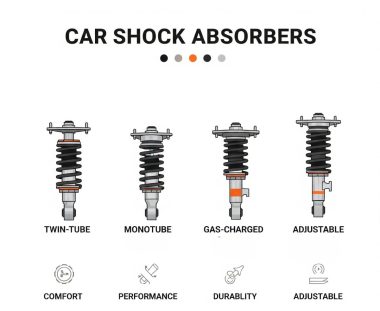
This infographic visually presents different types of car shock absorbers, including Twin-Tube, Monotube, Gas-Charged, and Adjustable, along with their key characteristics such as comfort, performance, and durability, all designed to enhance your driving experience.
- Budget-Friendly Options: KYB Excel-G and Monroe OESpectrum offer reliable performance at reasonable prices. Both provide good longevity and maintain ride quality well.
- Premium Choices: Bilstein B4 series provides OEM-quality performance with excellent build quality. Their monotube design ensures consistent performance across various conditions.
- Performance-Oriented: Bilstein B6 and Koni Sport series deliver enhanced handling without completely sacrificing comfort. These suit drivers wanting improved cornering ability and reduced body roll.
- Heavy-Duty Applications: For commercial vehicles or those regularly carrying heavy loads, Monroe Load Adjusting shocks or Bilstein B8 series provide the extra strength needed.
Making the Right Choice for Your Vehicle
Start by identifying your primary needs. Daily drivers prioritise comfort and longevity, while performance enthusiasts value precise control and handling improvements.
Consider your vehicle’s usage patterns. City driving with frequent stops benefits from different characteristics than motorway cruising or country road touring.
Budget plays a role, but remember that quality shocks typically last 50,000-80,000 miles. Investing in better components often proves more economical long-term.
While some experienced home mechanics tackle shock replacement, professional installation ensures proper setup and safety. Many suppliers offer valuable tips about shock absorber replacement from onlinecarparts.co.uk and similar specialist retailers.
Proper installation includes checking related components like springs, bushings, and mounting hardware. This comprehensive approach ensures optimal performance and prevents premature wear.
Your shock absorbers significantly impact your driving experience, safety, and vehicle control. Understanding the different types and their characteristics helps you make informed choices that match your specific needs and driving style.
Article written by Alena Kirsanova