


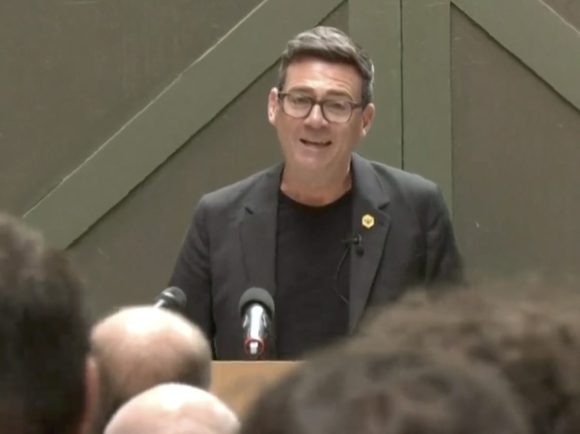
Andy Burnham faced criticism on Monday after refusing to answer questions from journalists following a major speech setting out his vision for Britain, with opponents arguing that the Labour front-runner had devoted more time to constitutional reform and devolution than to issues such as immigration, crime and border security.
The speech, delivered in Manchester on Monday, was intended to set out Burnham’s vision for the country and mark the start of a new chapter for Labour following Sir Keir Starmer’s departure.
However, journalists were informed in advance that there would be no opportunity to question the Labour leader after the address, a decision that immediately attracted criticism from political opponents and commentators.
The move meant there was no chance to seek clarification on several aspects of his proposals or to challenge him on issues that featured only briefly, or not at all, during the speech.
While Burnham spoke extensively about devolving power away from Westminster, strengthening regional government and creating a “No 10 North” in Manchester, there was comparatively little discussion of immigration, border security, the small boats crisis, crime or defence.
Those issues consistently rank among the public’s biggest concerns in national opinion polls.
Instead, Burnham focused on what he described as the need to “rewire” Britain, arguing that too much power remains concentrated in London and that local communities should have greater control over transport, housing, skills and economic development.
He pledged a major programme of council house building, reforms to technical education and greater powers for regional leaders.
Supporters argue that Burnham’s experience as Mayor of Greater Manchester gives him a strong understanding of how decisions made closer to communities can deliver better outcomes for residents.
Critics, however, questioned whether the speech focused too heavily on political structures and governance rather than the day-to-day issues affecting many families and businesses.
One observer told this newspaper:
“After nearly an hour setting out his vision for Britain, Burnham spent more time discussing councils, mayors, regional structures and constitutional reform than he did discussing immigration, border security, crime or defence. For a man who wants to be Prime Minister, that is a revealing set of priorities.
“It felt more like a speech from a metro mayor than a statesman preparing to lead the country.”
However, another journalist at the event took a very different view:
“Burnham spoke about how to fix the system rather than simply manage its decline. He was making a long-term argument about power, accountability and economic renewal. It may not have contained all the answers, but it was a serious speech from a politician who clearly believes in something.
“I don’t agree with him fleeing though. He should have answered our questions.”
Questions have also been raised about how some of the proposals would be funded, although Burnham reiterated his commitment to Labour’s fiscal rules and maintaining sound public finances.
For communities across the country, some of the proposals could eventually lead to greater local control over transport, housing and economic development decisions.
But with few detailed policy announcements and no opportunity for journalists to put questions directly to the Labour leader, much remains unclear about how his plans would work in practice.
The speech nevertheless offered the clearest indication yet of Burnham’s priorities as Labour leader, with devolution, regional growth and local decision-making set to play a central role in his agenda.
Whether voters are persuaded that those priorities reflect the issues they consider most important is likely to become a key political battleground in the months ahead.