


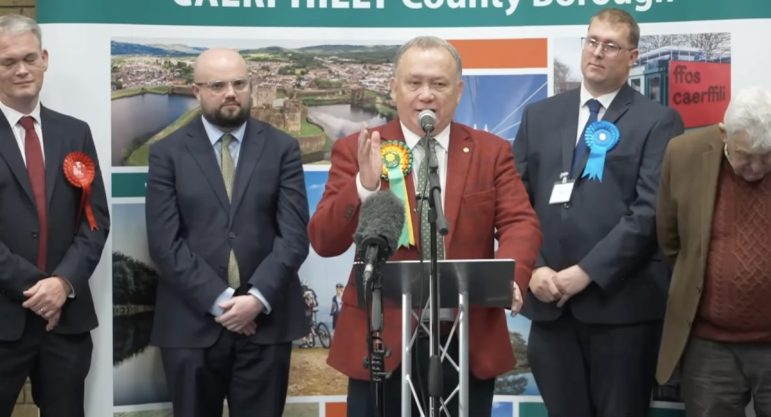
Labour has lost its century-long grip on one of its traditional Welsh heartlands, in a result described as a major turning point in the nation’s political landscape.
In a significant blow to Sir Keir Starmer’s leadership, Welsh nationalists Plaid Cymru won the Caerphilly Senedd by-election, ending Labour’s 100-year dominance in the former mining town.
The result marks the first time Labour has failed to win a parliamentary vote in Caerphilly in more than a century, signalling what observers described as a collapse in support for the party across Wales.
Plaid Cymru’s candidate, Lindsay Whittle, secured 15,961 votes, almost doubling the party’s tally from 8,211 in 2021. Reform UK came second with 12,113 votes, while Labour fell to third with just 3,713. Labour’s share of the vote dropped from 35 per cent to 11 per cent, while Reform rose sharply from 2 per cent to 36 per cent over four years.
‘The dawn of new leadership’
There were loud celebrations among Plaid Cymru supporters as Mr Whittle won the seat on his 14th attempt. In his victory speech, he said he hoped the result would mark “an exciting time for politics in Wales,” describing it as “the dawn of new leadership.”
Rhun ap Iorwerth, leader of Plaid Cymru, said:
“Tonight, the people of Caerphilly have spoken loud and clear.
They’ve chosen hope over division, and progress over the tired status quo, and backed Plaid Cymru’s positive, pro-Wales vision.
Lindsay Whittle is a tireless local champion who knows every community in this constituency inside out and will deliver real change for the people of Caerphilly.”
The result means Plaid Cymru now holds 13 seats in the Welsh Parliament, just one fewer than the Conservatives.
Labour vows to ‘learn lessons’
Welsh Labour’s leader, Baroness Morgan, thanked the party’s candidate, Richard Tunnicliffe, and described the by-election as “the toughest of circumstances.”
She said:
“This was a by-election in the toughest of circumstances, and in the midst of difficult headwinds nationally. I want to thank our candidate, Richard Tunnicliffe – a good man who stood because of his desire to serve his community.
“I congratulate Lindsay Whittle on his victory tonight. He returns to the Senedd, continuing his many decades of elected service to people in Caerphilly.
“Welsh Labour has heard the frustration on doorsteps in Caerphilly that the need to feel change in people’s lives has not been quick enough. We take our share of the responsibility for this result. We are listening, we are learning the lessons, and we will be back stronger.”
The defeat means Labour’s tally in the 60-member Senedd drops to 29, forcing the party to rely on other members to maintain a working majority.
Reform UK surges but falls short
Reform UK finished in second place, with a substantial increase in support but no victory. Its leader, Nigel Farage, joined the campaign trail earlier in the day but did not attend the count.
Reform’s candidate, Llŷr Powell, declined to give a speech after the result but told reporters:
“I think the person who should be embarrassed is Keir Starmer, who failed to turn up here because he doesn’t care about the constituency of Caerphilly, he doesn’t care about the people of Wales.
“They deserve to be [dead]. My goal is for a Reform government, I don’t care what they do. Right now I’m focused on a Reform government here in Wales and we’re going to move forward every day on that.”
The party is expected to attribute its defeat to tactical voting, though it will take encouragement from its rapid growth in vote share.
Political implications
The result is expected to heighten pressure on Labour’s leadership in both Cardiff and Westminster. The loss further complicates the Welsh Government’s efforts to pass its budget through the Senedd, a process that could lead to difficult spending decisions if cross-party support cannot be secured.
Labour has dominated Welsh politics for over a century and has won every devolved election since the creation of the Senedd in 1999. However, recent opinion polls suggest growing challenges ahead.
A YouGov poll last month placed Reform UK on 29 per cent of the Westminster vote in Wales, ahead of Plaid Cymru on 23 per cent and Labour on 18 per cent. The same survey found that just one in four voters who backed Labour in last year’s general election said they would do so in next May’s Senedd contest.
The Caerphilly result, analysts say, confirms that shift is already under way.