


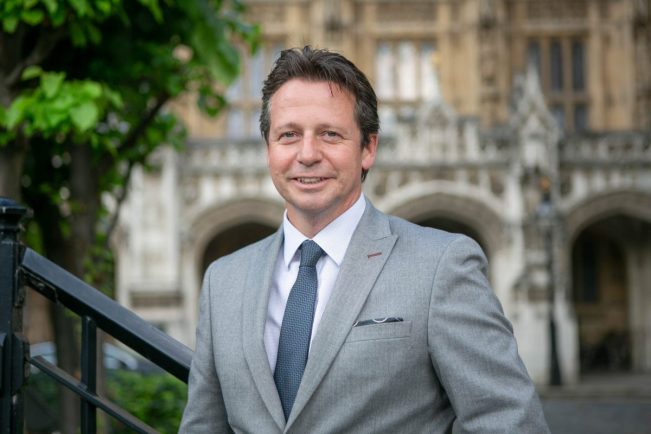
DROITWICH AND EVESHAM MP Nigel Huddleston has shared his ‘sadness’ after voting in favour of protecting high-quality agricultural land from solar development in parliament proved unsuccessful.
Supporting New Clause 39 of the Planning and Infrastructure Bill, Mr Huddleston voted alongside his Conservative colleagues to ‘prohibit the development of solar power generation on higher quality agricultural land.’
The land is also known as Best and Most Versatile (BMV) Land. However, the motion was defeated by 335 votes to 114, with the Liberal Democrats abstaining and the Labour Party voting against.
To Mr Huddleston’s disappointment, the motion was defeated by 335 votes to 114, with the Liberal Democrats abstaining and the Labour Party voting against.
Speaking about the vote, the Droitwich MP said: “I was pleased to vote in favour of the motion.
“As an MP representing a largely rural constituency, I have raised this issue frequently with Ministers – both in relation to specific solar developments here and more broadly in reference to national planning policy.
“I welcomed the previous Conservative Government’s position against using valuable agricultural land for solar projects.
“Sadly, however, the decision of Labour MPs to vote against this motion en masse shows yet again that this Government does not understand rural areas.
“Whether it’s the Family Farm Tax, the dramatic increase in housing requirements for rural areas (with a reduction for urban areas like Birmingham), or a lack of commitment to protecting our Best and Most Versatile land, and by extension, our food security, it’s clear that this Labour Government does not understand or support our rural communities, including here in Worcestershire.”
This vote comes after Mr Huddleston’s continued efforts to protect BMV land from solar development.
As well as writing to Ministers about solar farms, the impact of so-called “temporary” 40-year developments, and the effect on grazing, the MP also responded to the National Planning Policy Framework (NPPF) consultation last autumn.
He opposed any ‘relaxation of rules allowing development, whether for housing or other infrastructure such as solar farms, that would undermine our food security.’