

Sir Keir Starmer has formally stepped down as prime minister on Monday, ending a two-year premiership that began with a landslide election win and closed amid mounting pressure from within his own party.
He is succeeded by Andy Burnham, who will take office later in the day as Britain’s seventh prime minister in a decade.
Burnham, new Labour leader, who was crowned on Friday, will address the nation as prime minister for the first time this afternoon.
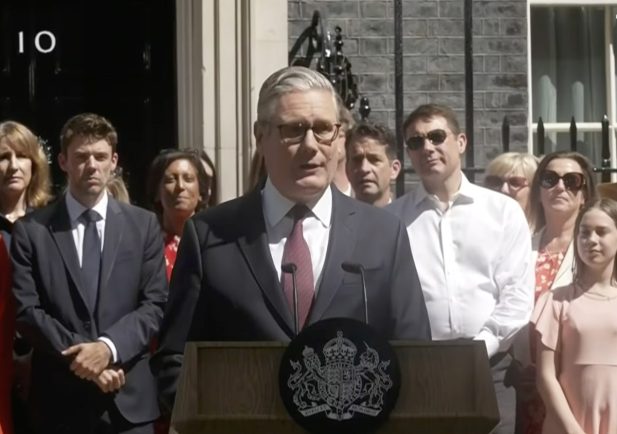
Starmer delivered a farewell address outside 10 Downing Street shortly after 11am this morning, telling the country his “work is done.” He said he was proud to leave Britain “stronger and fairer” than when he took office, pointing to falling NHS waiting times, lower immigration figures and Britain’s continued backing of Ukraine as among his achievements. He also referenced the biggest fall in waiting times in 17 years and progress in reducing child poverty.
Reflecting on six and a half years leading the Labour Party, Starmer recalled taking it from its 2019 general election defeat to a landslide victory in 2024, calling the premiership the privilege of his life. He wished Burnham “every success” and pledged his full support, while thanking his family, staff and the civil service for their work over the past two years.
Following the speech, Starmer travelled with his wife, Victoria, to Buckingham Palace, where he tendered his resignation to King Charles. The Palace confirmed shortly before 11.40am that the King had accepted the resignation.
In a statement, the palace announced:
“The Rt. Hon. Sir Keir Starmer MP had an audience of The King this morning and tendered his resignation as Prime Minister and First Lord of the Treasury which His Majesty was graciously pleased to accept.
“Lady Starmer was also received by The King.”
Burnham was due to have his own audience with the King around midday, after which he was expected to address the nation outside Downing Street as prime minister for the first time, at around 12.40pm.
Path to power
Starmer’s departure followed months of internal Labour turmoil. He first announced his intention to resign on 22 June, telling colleagues he accepted their doubts over whether he was the right person to lead the party into the next general election. The move came shortly after Burnham, the former mayor of Greater Manchester, won the Makerfield by-election on 18 June, returning him to Parliament and positioning him as the clear favourite to succeed Starmer. No rival challenger emerged, and Burnham was confirmed as Labour leader unopposed on Friday.
Starmer had led Labour to a 411-seat majority at the July 2024 general election, ending 14 years of Conservative government. His time in office was nonetheless marked by a series of policy reversals, including on winter fuel payments and the two-child benefit cap, alongside sustained pressure over taxes, the economy and immigration.
What comes next
Burnham takes office facing calls from opposition parties, including Reform UK’s Nigel Farage, for a fresh general election, given that Labour is not required to go to the country until 2029. Burnham has so far ruled out an early vote.
He is expected to move quickly on a reshuffle of the Cabinet, with several of Starmer’s closest allies, including Chancellor Rachel Reeves, widely expected to leave government. Burnham has signalled a shift toward greater state intervention, including possible steps on Thames Water and other utilities, alongside a renewed focus on devolution to England’s regions.